
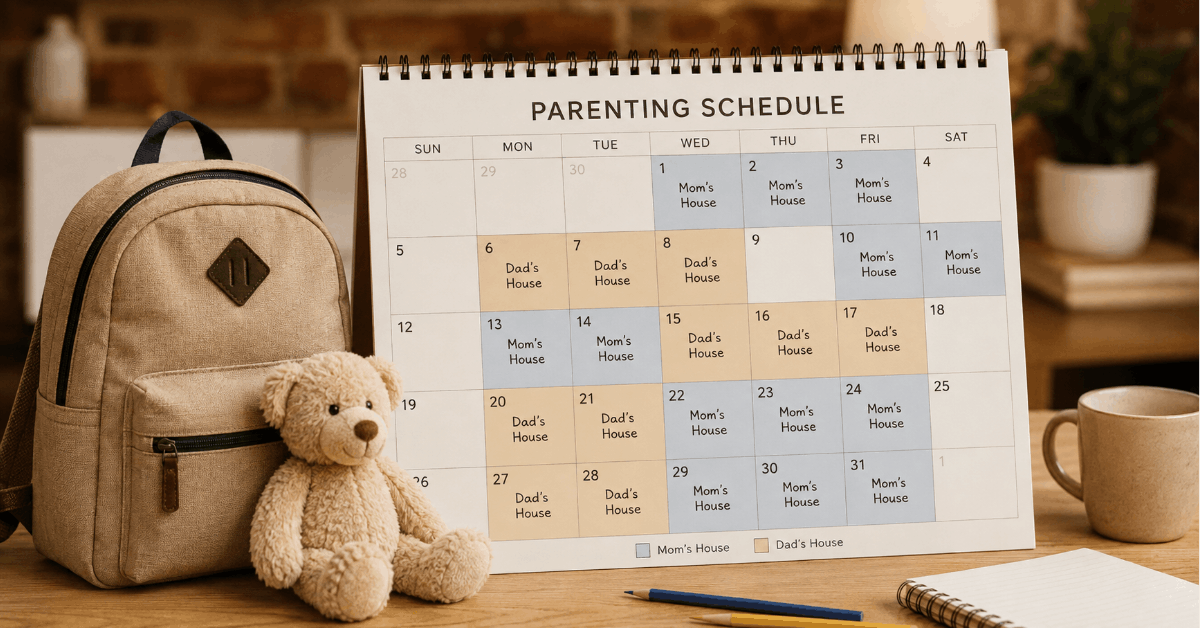
When parents separate or divorce, one of the most important decisions they will make is how their children will divide their time between two homes. A well-designed parenting schedule can provide stability, reduce conflict, and help children maintain meaningful relationships with both parents.
In Colorado, the allocation of parental responsibilities includes both parenting time (when the child is with each parent) and decision-making responsibilities (who makes important decisions about the child’s upbringing). Whether parents reach an agreement on their own or ask the court to decide, the parenting schedule should reflect the child’s best interests. Parents often choose to go with one of a few common parenting schedules, but an agreement can also be customized based on the child’s age, each parent’s work schedule, the distance between households, school commitments, and many other factors.
At Solutions Based Family Law, we know that there is no such thing as a one-size-fits-all custody arrangement. We work with our clients to help them decide what will work best for their families and work to get an appropriate parenting schedule in place. Contact our law firm to schedule a confidential consultation with a Denver child custody lawyer.
How Colorado Courts Decide Parenting Time
When deciding how to allocate parental responsibilities, Colorado courts are guided by one primary principle: the best interests of the child. When determining parenting time, courts may consider factors such as:
- The wishes of each parent
- The child’s wishes, depending on age and maturity
- The child’s relationship with each parent
- Each parent’s ability to place the child’s needs ahead of their own
- The child’s adjustment to home, school, and community
- The mental and physical health of everyone involved
- The parents’ ability to cooperate
- Any history of domestic violence, child abuse, or neglect
- The distance between the parents’ homes
Judges generally recognize that children benefit from having strong relationships with both parents whenever it is safe and appropriate.
Why Parenting Schedules Matter
A parenting schedule does more than determine where a child sleeps each night. It also establishes routines that affect nearly every aspect of a family’s daily life. A clear parenting plan can help:
- Create consistency for children
- Reduce misunderstandings between parents
- Minimize conflict over exchanges
- Clarify holiday and vacation schedules
- Improve communication
- Support school attendance and extracurricular activities
The more detailed a parenting plan is, the less room there is for future disagreements. Our Denver family law attorneys encourage parents to think about these issues when they are working on a parenting plan with their spouse. Negotiating a parenting plan jointly with your soon-to-be ex often helps you craft a schedule that works best for your family.
Common Colorado Parenting Schedules Explained
There are many different parenting schedules that co-parents can implement. This includes both schedules that are commonly used as well as completely customized plans.
The 2-2-3 Parenting Schedule
The 2-2-3 schedule is one of the most common arrangements for parents who share parenting time equally. In a typical rotation:
- Parent A has the children for 2 days.
- Parent B has the children for the next 2 days.
- Parent A has the children for the following 3 days.
- The schedule then reverses the next week.
For example, during week 1, Parent A has the kids Monday and Tuesday, while Parent B has the kids Wednesday and Thursday. Parent A then has the kids from Friday to Sunday. During week 2, Parent B has the kids Monday and Tuesday and Friday to Sunday, while Parent A has the kids Wednesday-Thursday.
The 2-2-3 schedule has several benefits. It offers equal parenting time and frequent contact with both parents. Young children spend relatively little time away from either parent, and it becomes a predictable routine once it is established.
However, the schedule does have drawbacks. Because children change homes frequently, it involves more exchanges and logistical coordination, plus increased communication between parents. This makes it a difficult option for parents who live farther apart or who have a high level of conflict.
The 5-2-2-5 Parenting Schedule
The 5-2-2-5 schedule is another popular option for families seeking equal parenting time. A common arrangement looks like this:
- Parent A has Monday and Tuesday every week.
- Parent B has Wednesday and Thursday every week.
- Parents alternate Friday through Sunday.
Over a 2-week period:
- Week One:
- Monday-Tuesday: Parent A
- Wednesday-Thursday: Parent B
- Friday-Sunday: Parent A
- Week Two:
- Monday-Tuesday: Parent A
- Wednesday-Thursday: Parent B
- Friday-Sunday: Parent B
This creates alternating five-day parenting blocks while maintaining consistency during the school week.
Many parents appreciate that the 5-2-2-5 schedule allows for consistent weekday routines, with kids knowing where they will be on school nights. Both parents will get weekend visits. There are fewer exchanges compared to a 2-2-3 schedule.
However, this schedule can be challenging for very young children, as it means longer stretches of time away from one parent. It also requires parents to cooperate on school transportation and extracurricular activities.
Alternating Week Schedule
For older children and teenagers, an alternating week schedule may work well. Under this arrangement:
- Parent A has the children for one full week.
- Parent B has the following week.
- Exchanges usually occur on Fridays, Sundays, or after school.
Some parents include one overnight dinner visit during the off week to maintain contact.
Alternating weeks provide fewer exchanges and less transportation. It also offers longer uninterrupted routines and easier scheduling for school and activities. Older children often appreciate having fewer transitions between homes.
For younger children, a full week apart may feel too long. Parents must also be comfortable going several days without seeing their children.
3-4-4-3 Parenting Schedule
Another equal-time arrangement is the 3-4-4-3 schedule. Children spend:
- 3 days with one parent
- 4 days with the other parent
- 4 days with the first parent
- 3 days with the second parent
This pattern creates longer blocks of parenting time while still maintaining equal parenting responsibilities. Many families find that it reduces exchanges compared to a 2-2-3 schedule.
Weekend Schedule
In some cases, one parent has the majority of parenting time while the other exercises parenting time every other weekend. Less commonly, the other parent may have the kids every weekend.
This arrangement may be appropriate when:
- Parents live far apart.
- One parent travels frequently for work.
- Equal parenting time is not practical.
- One parent has limited availability.
Although this schedule offers consistency, it may limit one parent’s involvement in school routines and weekday activities.
Customized Parenting Schedule
Not every family fits neatly into a standard template. Parents often develop customized schedules based on:
- Shift work
- Military service
- Medical needs
- Children’s extracurricular activities
- Homeschooling
- Seasonal employment
- Long-distance parenting
Colorado courts generally encourage parents to create parenting plans that reflect their unique circumstances rather than forcing every family into the same arrangement. Negotiating your own parenting schedule, rather than allowing a judge to decide for you, is one way that you can have more control over parenting time arrangements.
Considerations for Your Parenting Schedule
There are many different factors to consider when establishing your parenting schedule. This includes:
- Age of Your Children: Infants and toddlers benefit from more frequent contact with both parents, while elementary-aged children generally adapt well to predictable routines. Teenagers often have busy calendars, which makes schedules that reduce transitions and allow teens more flexibility a higher priority for older kids.
- Holidays and School Breaks: Regular parenting schedules usually do not control holidays. Most Colorado parenting plans include separate provisions for things like Thanksgiving, Christmas, winter break, spring break, summer vacations, long weekends, birthdays, and other special events. Parents often alternate major holidays each year.
- Transportation and Logistics: Even the best parenting schedule can become stressful without clear transportation arrangements. A parenting plan should address:
- Exchange times and locations
- Transportation responsibilities
- School pickups
- Delays
- Emergency situations
- Other Factors: Many other factors should be considered when developing a parenting plan, such as:
- The distance between households
- Each parent’s work schedule
- School and extracurricular commitments
- The level of communication between parents
- Each parent’s ability to maintain routines
- Your child’s personality and temperament
Rather than focusing solely on equal time, many parents benefit from asking which arrangement will provide the greatest stability and support for their child.
Keep in mind that children’s needs can and do change over time. A parenting schedule that worked well when a child was 4 years old may not meet the needs of a teenager. Parents’ own needs may also change, prompting a change in parenting schedules (such as a new job or relocation).
When parents can agree on a schedule modification, they can get an updated parenting plan approved by the court. If they can’t come to an agreement, a judge may decide whether a modification is appropriate based on the child’s best interests.
How a Denver Family Law Attorney Can Help
Developing a parenting plan involves more than selecting a schedule from a chart. Each family has unique dynamics, and a parenting arrangement should reflect your child’s individual needs. It should also account for practical realities like work schedules, transportation, school, and communication between parents.
At Solutions Based Family Law, we work closely with parents throughout the Denver area to create parenting plans that are both realistic and child-focused. Whether you are negotiating an agreement during divorce, establishing parental responsibilities for the first time, or seeking to modify an existing schedule, we can help you understand your options and advocate for an arrangement that serves your child’s best interests. To learn more or to schedule a consultation with a Denver family law attorney, give us a call at (866) 522-7959 or fill out our online contact form.