
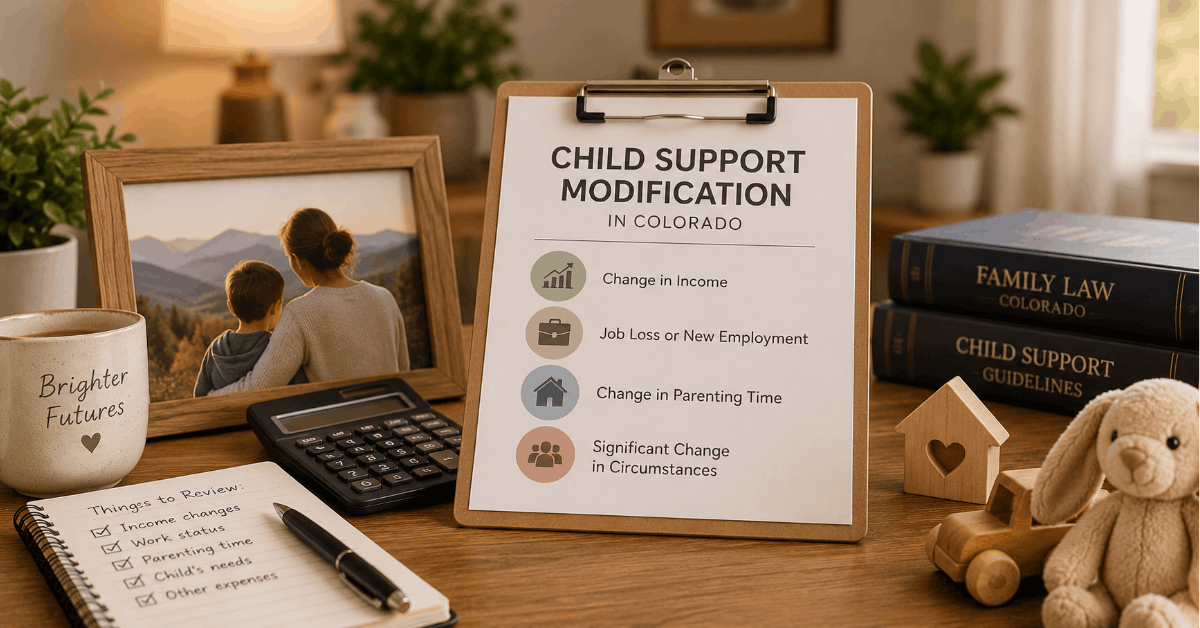
Child support is designed to ensure that children continue to receive the financial support they need after their parents separate or divorce. However, circumstances can and do change over time. Parents may change jobs, incomes can fluctuate, children may develop new needs, and family dynamics often evolve over time.
If your current child support order no longer reflects your family’s situation, it may be possible to modify it upwards or downwards. Colorado allows child support changes if there has been a substantial and continuing change in circumstances. However, parents cannot simply decide to pay less or demand more money on their own; any change to a child support order must be approved by the court.
At Solutions Based Family Law, we offer practical legal guidance to families in divorce, child custody, child support, and related matters. Our team can evaluate your child support order in light of your current financial reality and help to protect your financial interests. Contact our law offices today to schedule a confidential consultation with a Denver family law attorney.
How Child Support Is Calculated in Colorado
Before getting into modifications, it is helpful to understand how child support is determined. Colorado uses the Income Shares Model, which is based on the idea that children should receive the same proportion of parental income they would have received if their parents had remained together.
The court considers several factors when calculating child support, including:
- Each parent’s gross monthly income
- The number of overnight visits each parent has with the child
- Childcare expenses related to employment or education
- Health insurance premiums for the child
- Extraordinary medical expenses
- Other child-related costs recognized under Colorado law
Because these factors can change over time, the amount of child support may also need to change.
Can Child Support Be Modified?
Colorado courts recognize that life circumstances change. Either parent may ask the court to modify an existing child support order if certain legal requirements are met. Specifically, the requesting parent must prove that there has been a substantial and continuing change in circumstances to justify the modification.
A continuing change of circumstances means that the change is not temporary. While every case is unique, common examples of changes that may qualify for a modification include:
- A significant increase or decrease in either parent’s income
- Job loss or long-term unemployment
- A promotion or higher-paying position
- Disability or serious illness affecting earning capacity
- Retirement in appropriate circumstances
- Major changes in parenting time
- Significant increases in childcare expenses
- Changes in health insurance costs
- A child’s changing financial or medical needs
The court will examine whether these changes justify modifying the current support obligation.
However, child support does not automatically adjust when someone’s income changes or a child begins spending more time with one parent. Until the court approves a modification, the existing order remains in effect. If you stop paying the court-ordered amount without obtaining a modification, you may still be responsible for the unpaid balance, along with interest and possible enforcement actions.
A substantial change of circumstances means that applying the child support guidelines to the parents’ financial situation would result in at least a 10% change from the existing support order.
For example, if updated financial information results in a support obligation that differs by 10% or more from the current order, that difference may satisfy the legal threshold for modification. This rule helps ensure that child support orders remain fair as financial circumstances evolve.
Common Reasons Parents Request Child Support Modifications
Many different life events can lead to a request for modification. This may include:
- A Parent Loses a Job: Unexpected layoffs happen in every industry. If a parent loses employment, their income may decrease substantially. Depending on the circumstances, this could justify requesting a reduction in child support. However, voluntarily quitting a job simply to reduce support obligations is unlikely to receive favorable treatment from the court.
- A Parent Receives a Significant Raise: An increase in income may also justify modifying child support. Because Colorado’s guidelines are based largely on parental income, higher earnings may increase the amount of support owed.
- Parenting Time Changes: Child support and parenting time are closely connected. If a child begins spending significantly more or fewer overnights with one parent than originally anticipated, the child support calculation may change as well. Examples include:
- A parent becomes the primary residential parent.
- Equal parenting time changes to a different schedule.
- One parent relocates.
- A child reaches an age where the parenting schedule changes substantially.
Whenever parenting time changes significantly, it is worth reviewing whether child support should also be updated.
- Increased Childcare Expenses: Childcare costs often change as children grow older. A parent may experience increased daycare expenses due to:
- A new work schedule
- Before- or after-school care
- Summer childcare
- Educational programs
These expenses may affect the child support calculation.
- Medical Needs: Children sometimes develop medical conditions that require ongoing treatment. Changes in health insurance premiums, therapy expenses, prescription costs, or specialized medical care may justify reviewing child support.
However, not every financial change justifies modifying child support. Examples that may not support a modification include:
- Temporary fluctuations in income
- Minor raises or bonuses
- Short-term unemployment
- Voluntarily reducing work hours
- Choosing lower-paying employment without good cause
The court will evaluate whether the change is likely to continue and whether modifying support serves the child’s best interests. If you are unsure about the potential success of a modification request, our Denver child support attorneys can evaluate your case and advise you of likely outcomes.
Can Parents Agree to Change Child Support?
Parents may agree that child support should change, but they generally cannot make the change effective just by privately agreeing to do so. Instead, they should submit the proposed modification to the court for approval. Court approval helps to ensure:
- The agreement complies with Colorado law.
- The child’s interests remain protected.
- The new support amount becomes legally enforceable.
- Future disputes are minimized.
Without court approval, the original support order may still control, regardless of any private arrangement.
How to Request a Child Support Modification
In most cases, Colorado child support modifications are not automatically retroactive. This means that any modification to child support would begin on the date the motion was filed, not when the situation itself changed. If you believe that your circumstances justify modification, it is a good idea to talk to a lawyer so that you can move forward with a formal request. To file for a child support modification, you should:
- Review Your Current Order: Carefully examine the existing child support order and determine whether circumstances have changed significantly.
- Gather Financial Information: You will need documentation to support your request, such as:
- Recent pay stubs
- Tax returns
- W-2s or 1099s
- Health insurance information
- Childcare expenses
- Proof of income changes
- Documentation regarding parenting time
Complete and accurate financial information helps the court evaluate whether modification is appropriate.
- File the Appropriate Motion: The parent requesting modification files the necessary paperwork with the court. Additional documentation and supporting evidence are usually required.
- Exchange Financial Disclosures: Both parents may be required to provide updated financial information so the court can accurately calculate child support under the current guidelines.
- Court Review or Hearing: If both parents agree, the court may approve the modification without litigation. If they disagree about the modification, a hearing may become necessary. Each parent will present evidence about income, expenses, parenting time, and other relevant factors. The court will then make a decision and issue an order.
Until a modification is approved, existing child support obligations are enforceable. Failing to pay court-ordered support may result in serious consequences, including:
- Wage garnishment
- Tax refund interception
- Suspension of driver’s or professional licenses
- Liens against property
- Interest on unpaid support
- Contempt of court proceedings
If you are unable to make your current payments, seeking a modification through the proper legal channels is a far better option than simply stopping payments. If you are unsure of your rights, our Denver child support lawyers can analyze your case and help you determine the best way to move forward.
Compassionate Legal Representation for Colorado Families
Whether you are seeking an increase or decrease in child support, understanding your legal rights is the first step. Colorado’s child support laws are designed to balance the financial abilities of both parents while ensuring children receive the support they need. When circumstances change, modifying an outdated support order may be appropriate.
At Solutions Based Family Law, we help parents throughout the Denver area navigate child support modifications with practical, personalized legal guidance. Whether your income has changed, your parenting schedule has been updated, or your child’s needs have evolved, our experienced Denver child support lawyers can explain your options and advocate on your behalf. To learn more or to schedule a consultation with a Denver family law attorney, give us a call at (866) 522-7959 or fill out our online contact form.