
Domestic violence is unfortunately far too common in Colorado and across the United States. In Colorado, if you believe that your safety is at risk, you may be able to seek a protection order. You can also oppose the issuance of a protection order if you believe that your ex is wrongfully seeking an order to gain an advantage in court proceedings.
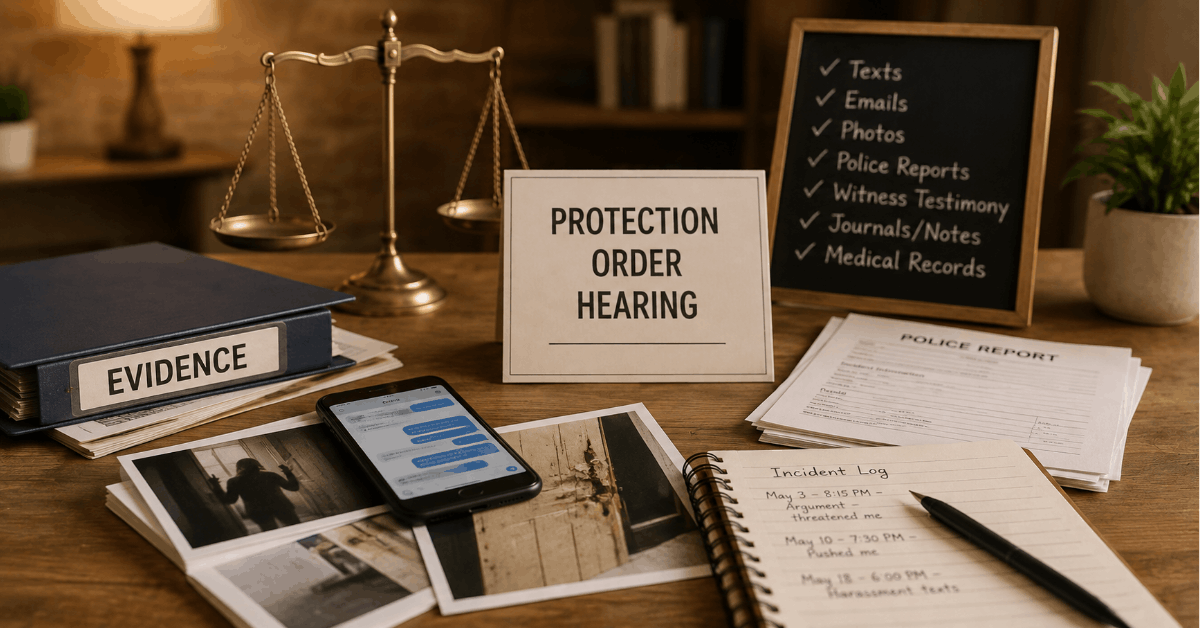
Whether you are seeking or opposing a protection order, evidence such as witness testimony, records of communications, photos, and videos can be incredibly helpful for your case. The evidence should either go to prove or disprove that an imminent danger exists to the person seeking the order. If you are involved in this type of case, our Denver protection order lawyers can help you gather evidence and will advocate for you in court.
At Solutions Based Family Law, we have broad experience handling both Colorado family law matters, including divorce, child custody, and spousal support. We take a strategic approach to family law cases, using our experience to help our clients get the best possible outcome. Contact our law firm today to schedule a consultation with a Denver family law attorney.
What Is a Protection Order?
A civil protection order, which is sometimes referred to as a restraining order, is a court order that protects one party by placing restrictions on another person. These restrictions may include limits on communication, certain conduct, and how close the person can get to the protected party. Violation of a protection order is a criminal offense in Colorado.
The purpose of a civil protection order is to “promote safety, reduce violence and other types of abuse, and prevent serious harm and death.” A court may issue a protection order if it determines that there is an imminent danger to the person(s) seeking the order. A court will consider all relevant evidence in making a decision about whether or not to issue a protective order.
Under Colorado law, a court may issue a protection order that includes terms such as:
- Restraining the other party from threatening or harming the protected party or their child;
- Prohibiting contact with the protected party or their child;
- Excluding a party from entering the family home or the home of another;
- Awarding temporary care and control of children for up to a year;
- Protecting against interference with the protected party’s workplace or school; and/or
- Protecting the pets or animals of the protected party.
A court can also enter a temporary injunction to order the restrained party to continue paying household bills and other expenses. This type of order can be used to prevent financial abuse of the protected party.
Seeking a Protection Order in Colorado
If you are currently in divorce proceedings with your soon-to-be ex, then you do not need to file a separate petition for a protection order. Instead, your Colorado divorce lawyer can file a motion seeking a protection order as part of the dissolution proceedings.
In some cases, you may need a protection order separate from a divorce case. In this situation, you will need to:
- File a Verified Complaint/Motion for Civil Protection Order (JDF 402).
- Include all information needed for the complaint, including:
- Reasons for seeking the protection order
- Where the protected person lives and works
- Information about any shared children
- Information about any incidents that led to the request for the protection order, including past incidents and the most recent incident
- Whether there are any other protection orders in place
- File the completed complaint with the Clerk of Court at the county courthouse.
- Attend an ex parte hearing, where the other party will not be present. If the judge finds that there is an imminent danger and the protection order is necessary to prevent violence or abuse, they will issue a temporary protective order.
- Serve the Temporary Protection Order on the restrained party, typically through a private process server or the county sheriff’s office.
- Attend the Permanent Protection Order hearing, which will be set within 14 days. This hearing is more extensive, with both parties having the right to appear and present and/or challenge evidence. If the restrained party does not appear, then the court will enter the Permanent Protection Order.
- If the judge finds that the respondent has committed acts that justify the issuance of a restraining order, they will issue a permanent protection order. For this type of order, there is no need for the court to find imminent danger.
A Temporary Protection Order will take effect as soon as it is served on the restrained party. However, the restrained party may be able to enter a shared home to get their personal effects if accompanied by a peace officer.
Keep in mind that a violation of a temporary or permanent protection order is a crime. If you are the restrained party, then you must be aware of the conditions of the order to avoid a violation. If you are the protected party, you can call law enforcement if the other party violates the order.
While it is possible to represent yourself in a protection order proceeding, it can also be helpful to work with an experienced Denver protection order attorney. Our lawyers will analyze the facts of the case, gather evidence, and advocate for your interests in court.
What Evidence Can Be Used to Support or Oppose a Colorado Protection Order?
The Colorado Court System offers an incident checklist to help you prepare for a protection order hearing. This checklist offers a good overview of the types of conduct that may justify seeking a protection order, such as:
- Name-calling/directed use of obscenities
- Threatening/harassing phone calls
- Threat of injury to self or others
- Threat by physical or sexual abuse to children
- Threat by cruelty to animals
- Threat by following
- Threat by damage to property
- Throwing things
- Grabbing
- Shoving or pushing
- Forcing sexual conduct
- Physically or sexually abusing children in the household
- Slapping with an open hand
- Punching with a closed fist
- Kicking
- Using weapon
- Biting
- Choking or strangling
- Beating
- Forcing other to stay in closet, room, homes, or other locations
Any type of evidence that could prove or disprove these allegations can be helpful in a permanent protection order hearing.
In many cases, digital evidence plays a big role. Text messages, calls, and other types of messages may be used to show threats or to prove that some type of abuse occurred. For example, if your ex sent a text apologizing for slapping you, that might go to show that the physical abuse did occur.
Other types of digital evidence may be useful as well. If the other person installed a GPS tracker on your vehicle, proof of that may be useful to show stalking. Photos and videos of incidents and injuries may also be evidence to support or disprove allegations of abuse.
Witness testimony can also be critical in protection order hearings. In many cases, witnesses can testify that they saw the abuse firsthand or that they have never seen any abusive behavior. For example, a witness might testify that during a fight between the parties, it was actually the person seeking the protection order who struck the restrained person first.
These cases are often complicated and very emotionally charged. They can also become important in related cases, such as divorce or the allocation of parental responsibilities. Any allegation of domestic violence should always be taken seriously. If you are involved in a matter related to a protection order in a Colorado family law case, our Denver protection order attorneys can represent your best interests.
Work with a Colorado Protection Order Lawyer
Protection orders can be an important way to gain some measure of safety if you are or were in an abusive relationship. While obtaining an initial temporary order is relatively straightforward, you will need evidence to prove the allegations for a permanent protection order. Our law firm can help you put together a strong case to either support a request for a protective order or oppose the request.
Solutions Based Family Law represents clients throughout the greater Denver area in a range of family law matters. We also offer representation for issues related to domestic violence, including seeking or opposing protection orders. Give us a call at (866) 522-7959 or fill out our online contact form to schedule a consultation with a Denver protection order attorney.